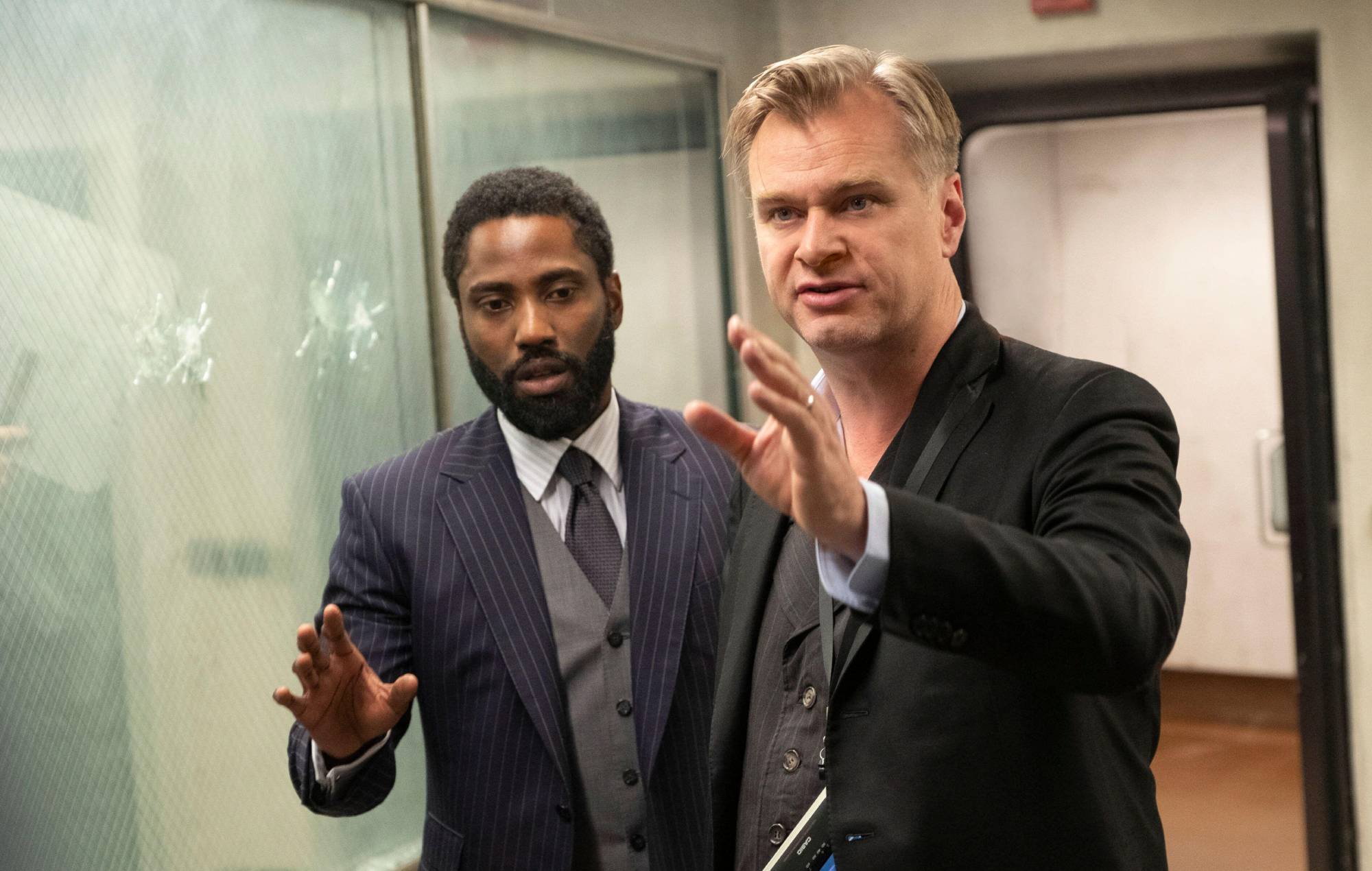
The hype around Dunkirk proved once again that Christopher Nolan is one of the most important directors today. Our video review is about what makes his creative handwriting unique: from experiments with drama and manipulation of time to visual style and special effects
Christopher Nolan is one of the key directors of our time, an outstanding screen illusionist, the creator of the “intellectual blockbuster” phenomenon, and, according to the most ardent fans, a cinematic genius. He went from microbudget independent films made “on the knee” to the most expensive and large-scale films in the history of cinema. He breathed new life into the comic book genre, brought some seriousness into it, and transformed big Hollywood productions with bold experiments with drama. Nolan’s filmography is diverse, but the authorship of any of his films is instantly recognizable. Let’s see why – what makes up the unique directorial style of Christopher Nolan and what makes each of his films an event in the world of cinema.
Dramatic art: nonlinearity and twists
It is with drama that the most characteristic feature of Nolan’s cinema is associated. His films are often called “intellectual blockbusters” because his plots are a kind of puzzles that require, while watching, not so much empathize as think and solve problems. Secondly, his stories are non-linear, that is, events on the screen unfold not in chronological order, but in the order that is necessary for the implementation of the author’s intention.
Nolan’s main action is always diluted with flashbacks, flashforwards, memories or dreams. For example, already in the debut “Pursuit” the narrative is built according to the principle of a mosaic – from episodes taking place at different times, the overall picture is gradually formed. This helps to create intrigue and bring out the ambiguity of the characters.
Nolan’s most difficult film in terms of drama is Remember. One story is revealed here by two alternating lines – sequential and reversible. So the author wanted to make the viewer feel in the place of the main character – a patient with a complex form of amnesia.
A passion for non-linearity determines several other features of Nolan’s drama. His paintings usually open with a spectacular scene from the middle or from the end of the narrative. This is how the director creates tension, intrigue, a sense of mystery and anticipation of a fascinating story. It is interesting that opening shots are usually repeated later, but in the context they are perceived by the viewer differently.
The end is often no less mysterious than the beginning. Nolan loves unexpected ending twists that change our view of the whole story, as well as open endings that leave the viewer uncertain about the fate of the heroes.
Another dramatic feature is the use of the narrator’s voiceover. The narration is either conducted on behalf of one of the heroes, or periodically commented on. This gives the story subjectivity, fills it with personal intonation, sets a definite point of view on events and, as a result, brings the hero closer to the viewer.
Plots: dualism and time
Continuing the theme of drama, let’s look at the plot motifs that are regularly repeated in Nolan’s work. Let’s start with the motive of the dualism of human nature.
Many of Nolan’s characters are not who they initially appear. Heroes under the pressure of external circumstances, due to a mental disorder or as we get to know them, become antiheroes, victims turn into villains and vice versa. The internal conflict of Nolan’s characters is often associated with the theme of the loss of a loved one: parents, lovers or children. Accordingly, the motive for action is the desire for revenge, as in Remember, or the desire to overcome the separation, as in Inception or Interstellar.
But, perhaps, the key topic that worries Nolan is time. For example, in “Prestige” his hero tries to deceive time with the help of science. In “Inception”, time slows down as the characters plunge into deeper and deeper levels of sleep. In Dunkirk, the action unfolds in parallel in three time frames. In Remember, time does not exist for the protagonist, because memory does not exist. And in Interstellar, time changes the speed of the flow according to the laws of the theory of relativity, and in the end it is completely overcome by the hero. Perhaps it is this theme that defines Nolan’s passion for non-linear drama as a way of manipulating time.
Parallel installation
Closely related to the theme of the time is Nolan’s favorite editing technique – parallel editing. The director masterfully works with this oldest cinematic technique. It involves the simultaneous development of several storylines on the screen. As a rule, the director resorts to such a decision at the climax, emphasizing the interconnection of events and mutually reinforcing the emotional sound of the scenes. The culminating episodes of Prestige, Interstellar, and Inception are prime examples.